Świeradów-Zdrój with Children, Without Guesswork: How to Match Routes, Pace and Attractions to Their Age
The best family plan in Świeradów-Zdrój does not always head straight into the mountains. This practical guide helps you match the route to your time, fitness, the child’s age and the weather—from a walk by the Spa House, through the educational Zajęcznik trail, to the gondola, Stóg Izerski and a trip across to the Czech side.
The best family plan in Świeradów-Zdrój often begins by abandoning the mountain objective. This is not excessive caution but sensible energy management: a child who still wants to keep walking after an hour in town gives the family a much better outlook for Zajęcznik or the gondola than a child taken straight onto an ambitious ascent.
Instead of asking only “what is there to see?”, start with four decisions: how much time you have, whether you need a loop or a route with a return option, how quickly the family takes breaks and what the reward should be—a playground, forest, view, educational experience or hot meal. In Świeradów-Zdrój, you can build a day for a preschooler, a school-age child or grandparents travelling with grandchildren, but each of these groups should have a different plan.
Choose your pace first, and only then the destination
A family outing in the mountains should not be a test of character. A child does not have to “endure” a route chosen by adults. A plan that ends with everyone wanting a little more is better than an ambitious loop that ends in tears, cold and a frantic search for transport.
- Have you got around an hour or an hour and a half? Stay in the spa centre: take a walk by the Spa House, explore Spa Park and the Walkway Hall, then have a relaxed meal.
- Have you got two hours and does your child enjoy tasks? Choose Zajęcznik, a short educational forest trail.
- Do you want to get higher quickly, but do not know how much energy will be left for the ascent? Take the gondola and decide at the top whether the walk will end at the viewpoint or continue farther.
- Have you got most of the day, older children and energy to spare? You can plan Stóg Izerski, Smrek and a route on the Czech side, but set a clear turning-back point.
Age is only a rough guide. A six-year-old who has been hiking for several seasons may cope better than a nine-year-old accustomed exclusively to urban walks. More important are the length of previous outings, tolerance for uphill sections, the ability to rest and whether the child accepts returning by the same route.
Youngest children: the spa as a destination in its own right
For preschool children, the centre of Świeradów-Zdrój is not a substitute version of the mountains. It is the safest testing ground for seeing how the family functions outside its accommodation. A shorter walk makes it possible to find a toilet, food and somewhere to rest without having to organise a retreat from a forest trail.
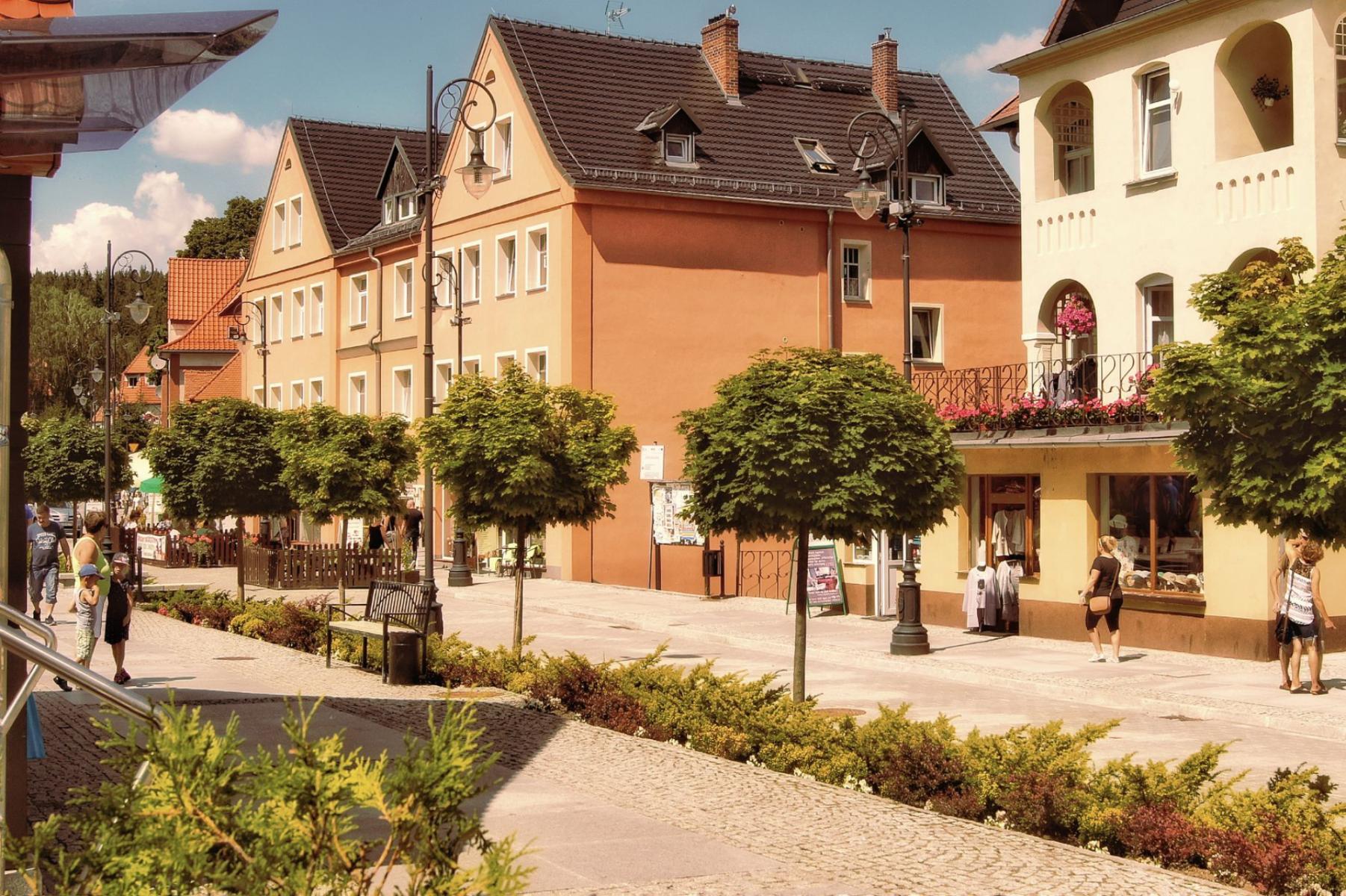
A good starting point is the Spa House with its Walkway Hall. The larch-wood hall is around 80 metres long and is one of the spa’s most distinctive features; the main entrance also leads to a mineral-water pump room.[1] For a child, the space itself is easier to understand than a museum exhibition: you can walk through it, stop, look at the details and return outside without pressure.
Spa Park and the area around the promenade are best treated as a loop made up of several short sections, not as a march towards a particular kilometre mark. After each section, check whether the child is still walking at their own pace. If they start to become restless, hungry or ask to be carried, the day does not need rescuing with another attraction. A break and an earlier return will be enough.
With a pushchair, the key issue is not simply whether it is possible to get around town, but the logistics. Before setting out, decide where you will stop for feeding, changing and a meal. Do not put off using the toilet “until later”, because later often means the crisis has already begun. For grandparents travelling with grandchildren, this urban option has another advantage: the day can be split into two short outings instead of trying to fit everything into one long route.
Zajęcznik: the best test before a longer excursion
If you want to see how your family manages forest terrain, a gentle ascent and breaks outside town, start with Zajęcznik. The official route description gives the return journey as taking around an hour and a half, classifies it as easy and recommends it for families with children.[2]
This is not simply a walk with information boards to read. The educational trail has nine stations that engage visitors, covering such subjects as the inhabitants of the Izera forest, dendrology, the food chain and identifying animals.[2] This gives the child specific tasks, while allowing the parent to regulate the pace without creating the feeling that everyone is merely “walking uphill”.
It is best to plan Zajęcznik as a self-contained half-day outing. Do not automatically add the gondola, lunch, shopping and another route simply because the official walking time seems short. Children stop at the stations, return to interesting features, want to investigate something or take a longer rest. An hour and a half on the map can therefore translate into a distinctly longer family rhythm for the day.
A pushchair should not be assumed to be suitable without checking the current condition of the surface. The official description refers to an interactive forest trail, not a pushchair-friendly route.[2] For a younger child, a carrier or a plan that assumes they will walk short sections independently will be safer. It is also worth telling the child that reaching the end at all costs is unnecessary. If clear tiredness appears after a few stations, turning back is the right decision, not a failure.
The gondola: a tool for managing exertion, not just an attraction
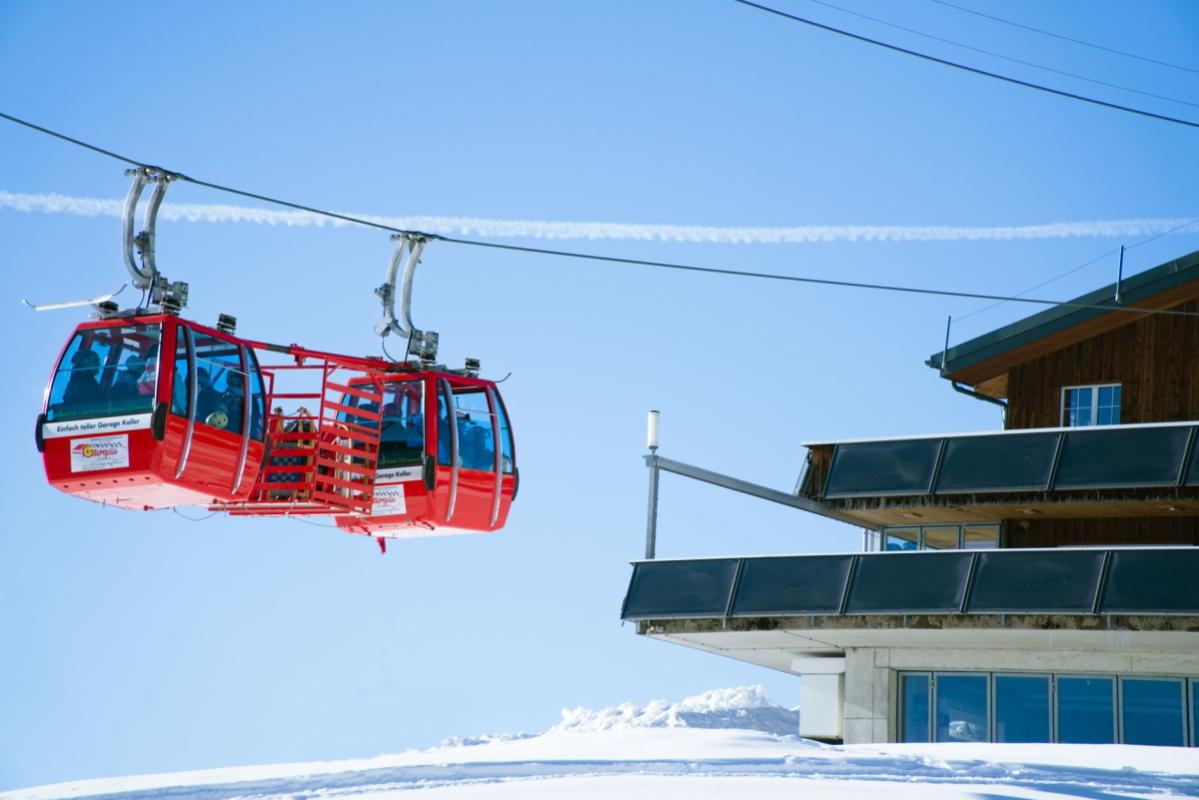
The gondola lift allows you to separate two questions that families often combine: “do we want to see the mountains?” and “do we want to spend a long time walking uphill?”. You do not have to answer yes to both. You can ride high, walk a short section, rest and ride back down if a child or older family member has no reserve left.
According to the town guide, the lift is around 2,172 metres long, climbs approximately 443 metres and takes roughly eight minutes.[3] From a family’s point of view, this significantly changes the plan: instead of using up your energy on the entire ascent, you can spend it on a walk at the top, a viewpoint or an unhurried return.
The operator’s regulations provide for the free carriage of pushchairs, as well as hand luggage and wheelchairs. Children under four may travel free of charge on presentation of a document confirming their age, while children and young people under fifteen use concessionary tickets according to the price list.[4] This does not mean, however, that every onward section after the ride will be convenient for a pushchair. The gondola solves the transport to the top, not the entire logistics of the walk.
The most practical option looks like this:
- Use the toilet and have a snack before boarding.
- Check that the lift is operating and what conditions are like at the top.
- Ride up without declaring in advance how far you will walk.
- Take a short break after leaving the gondola.
- Decide whether to return by lift or continue walking.
Do not buy an ambitious route along with your ticket. First see how the family responds to the altitude, open space and change in temperature. An extra layer of clothing takes up less room than the problem that may come later, especially when it was warm below and the children stop moving at the top.
Stóg Izerski and the Czech side: for older children with time to spare
Walking independently from Świeradów-Zdrój up to Stóg Izerski is no longer a “walk while you are there”. The official description of the red trail gives the distance as around 4.5 kilometres one way, with 569 metres of ascent and approximately two and a half hours of walking; it also notes that the final shortcut is steep, rocky and tiring.[5] For a family with a preschooler, this option should be an exception, not the default plan.
A much more sensible arrangement for older children is to take the gondola up, rest by Stóg and only then choose the onward direction. The town guide gives the distance from the upper station towards Smrek as around 2.2 kilometres, taking approximately 40 minutes.[3] This can be an appealing objective for a school-age child who needs a specific destination at the end of the route but does not want to walk all day without making decisions along the way.
Heading across to the Czech side requires a greater time margin than walking to a viewpoint. It is not only a matter of crossing the border. You need to allow for breaks, taking a wrong turn, a slower pace and getting back to a place from which you have realistic transport. A child may be able to walk another two kilometres, but may not necessarily want to return by the same route afterwards.
So agree on three checkpoints in advance: the place at which you will finish without discussion, the time at which you will turn back regardless of your destination and the return option. If the family is already tired at Stóg, the Czech observation tower should not be treated as “just a little farther”. If everyone is walking comfortably and you have food, water and time, you can continue.
Rain, hunger and breaks: have Plan B ready before you leave
The best emergency plan does not begin when it starts raining. By then, the child is already tired, the parents are searching for a signal and every closed attraction becomes a catastrophe. In Świeradów-Zdrój, it is worth having at least two options: a short urban one and an educational one under cover.
The Natura 2000 “Izerska Łąka” Environmental Education Centre gives presentations on the nature of the Izera Mountains, bees, astronomy and light pollution. Visits take the form of presentations lasting around 40–50 minutes, and places must be booked because capacity is limited.[6] It is a good destination for children who need something concrete: a film, observation, questions and a short, self-contained programme instead of another walk.
Do not treat Izerska Łąka as somewhere you can always simply walk into from the street. Before setting out, check the current day, time and booking arrangements. The plan is simpler for the Walkway Hall, but here too it is worth remembering that the building and pump room have their own opening hours, which change independently of the weather.
It is best to plan food in two stages: a small snack immediately available in the rucksack and a proper meal in town or after coming off the trail. A child who waits until the end of an ambitious outing to eat may not appreciate even the best destination. Water should be available without negotiation. The pump room by the Spa House is part of the spa’s heritage, but it does not replace the family’s own supply of drinks for the entire walk.
When to turn back—and how not to turn it into an argument
It is worth setting the rules before you leave. Turn back when the child is clearly cold or wet, starts regularly falling behind, stops responding to their surroundings, complains of pain or is unable to rest during a break. Do not wait until you have to carry them for the entire route.
A message that works well is: “We’ll walk to the next resting place and decide there.” It is specific, does not sound like a punishment and allows the child to take part in planning. With older children, you can add a time limit: if you are not at the agreed point by a particular time, you turn back without negotiation.
For grandparents travelling with grandchildren, the safest approach is a two-speed rule: one person walks ahead with the child, while the other keeps an eye on the group’s pace and belongings. The gondola, an urban walk and Zajęcznik make it easier to divide up roles than a long ascent at a constant gradient.
In Świeradów-Zdrój, you do not have to see everything during a single stay. The best decision is often: the Walkway Hall and Spa Park today, Zajęcznik tomorrow, and only then the gondola and the Czech side. The mountains will still be there, and the family will have the energy to truly enjoy them.