Equipment, service and setup: how to prepare your bike (and e‑bike) for Izera singles, Bike Park Świeradów and a trip to Singletrack Glacensis
Smooth singletracks under the spruces, fast rollers and long arcs on crushed stone — the Izera trails reward those who set tires, suspension and brakes correctly. This guide combines workshop know‑how with the realities of Smrk, Bike Park Świeradów and the Singletrack Glacensis network so you ride faster, with more confidence and visit the shop less often.
The first thing you feel under Smrk is the cool conifer gloom and the smell of resin. The gravel under the wheels gleams like wet graphite, the turns are shaped, and the flow pulls you in faster than you can fasten the straps on your helmet. These are mountains where riding technique meets trail engineering — and where a few smart maintenance and kit decisions can turn a day into the best ride of the season.
How to read the colours and choose lines intentionally
Most local singletracks — both on the Polish side around Świeradów and on the Czech side as part of Singltrek pod Smrkem — use an established difficulty scale: green (easiest), blue, red, black. It’s a language that speaks about geometry, surface and gradient, not speed — that you set yourself. The system comes from IMBA practices and ski resorts: easy green, intermediate blue, advanced black; in places you’ll also find double black for expert lines[1][4].
There’s one important exception on Smrk that we put on a planning pedestal: the green starter section is the only two‑way part of the network — it serves as a wide connector and access track. The rest of the trails are designed as one‑way, which helps manage traffic and lets you “read” the profile of berms without surprises from oncoming riders[1].
In practice: if you’re moving over from wide gravel tracks, start with the green and blue loops to accustom your eye to the guiding edges and the rhythm of pump features. Red routes give longer, faster sections and more bodywork; blacks can be steeper, with narrower benches and less time to react. The progression rule is simple: move up one colour only when you can ride the previous one smoothly without “braking from fear.”
Tires, pressures and drivetrain for real Izera conditions
Tread choice and going tubeless
Izera singletracks are a mix of compacted crushed stone, local roots, conifer litter and — after rain — thin, wet films on rocks. Set your tires therefore for “flow with a margin”: a front with a more open all‑mountain/traction tread, a rear with a faster micro‑knob design. Widths of 2.35–2.5" give a stable footprint in shaped berms and a calmer loft over rollers; on e‑MTBs consider stronger casings and inserts that save rims at lower pressures.
Tubeless here is not a luxury but the standard. A slightly thicker‑formula sealant handles small cuts from the ballast better. If you like to experiment: on a drizzly morning add 0.1–0.2 bar compared with your “dry” setting so you don’t “float” off the edges of berms, but don’t kill the sag entirely — that’s what makes traction in corners.
Reference pressures
- Hardtail/trail 29" (rider 70–80 kg): front 1.6–1.8 bar, rear 1.7–1.9 bar.
- Full 29" with a softer compound: front 1.5–1.7 bar, rear 1.6–1.8 bar.
- e‑MTB: typically +0.1–0.2 bar vs. analog, or consider an insert in the rear tyre.
These are starting points. Reduce by 0.1 bar if the trail feels bouncy and you lack grip in long berms; increase by 0.1–0.2 if you feel the tyre squashing on the edges or the rim bottoming on compressions.
Drivetrain: keep it quiet
On predictable, fast flow the most annoying thing is… a noisy chain. Tighten the clutch on the derailleur, check the jockey wheels, add a light protector on the downtube. Carry a quick‑link for the chain and a thin spare derailleur cable — failures are rare, but when they happen the day is over. Lube? One that doesn’t turn into a paste with dust; drops rather than a bath.
Brakes, cockpit and suspension: set it once, you’ll feel the difference always
Brakes and rotors
Riding only singles? 180 mm front and rear is a sensible minimum for riders up to ~80 kg. If you plan repeated, long gondola descents or you ride a heavier e‑MTB — 200/203 mm up front gives a buffer against overheating and a shorter time to the “let go and turn” point. Pads: resin for quietness and modulation in the cool forest, metallic for hot, long days — carry a spare set in your pack.
Cockpit
- Lever angle: generally 30–40° down from horizontal. On steeper black sections — a little lower; on flowing berms — flat = better wrist control.
- Handlebar width: if your bars are “searching” for trees, reduce 760–780 mm to something that doesn’t compromise stability but lets you freeride‑style “lay the bike over.”
- Stem: a shorter stem (35–50 mm) helps load the front in turns and makes quick line corrections in berms easier.
- Dropper post: a must‑have on singles. You’ll descend more smoothly, and getting back up to stand won’t tire your back.
Suspension
On Izera flow‑trails a trail SAG works well: fork 20–25%, damper 28–30%. Set rebound so that after compressions the bike returns decisively but doesn’t “kick” — test on a series of rollers, looking for the tempo where the wheel stays glued to the ground. If you feel bottoming on outside compressions of turns — add a token or raise air pressure slightly. If the bike is nervous over root mats, back off one click of rebound.
e‑MTB: simple habits that genuinely extend battery life
e‑MTB motor manufacturers have repeated the same set of good practices for years — and they work regardless of the badge on the cell casing. A few rules that hold in the mountains:
- Avoid temperature extremes: don’t heat the battery in a car in the sun, don’t leave it in freezing cold. Store in moderate conditions and don’t charge “hot” immediately after a hard climb.
- For longer storage leave the charge around half (roughly 30–70%). Don’t keep it at 100% for weeks.
- Charge to full just before a long day, but day‑to‑day finish charging around 80–90% if possible.
- Don’t hammer everything in “Turbo” mode: smart mixing of modes saves energy and temperature. Change cadence — a high cadence is kinder to the motor than slow, brute‑force pedalling.
- During transport in a gondola or car lock the suspension and switch off power; keep contacts clean and dry.
If you plan an all‑day loop that returns across the border, calculate real range on the elevation profile. In the Izeras the emphasis is on steady flow, but the sum of short climbs can drain a battery faster than “one big wall.”
Logistics: the Ski&Sun gondola to Stóg Izerski and into the trails
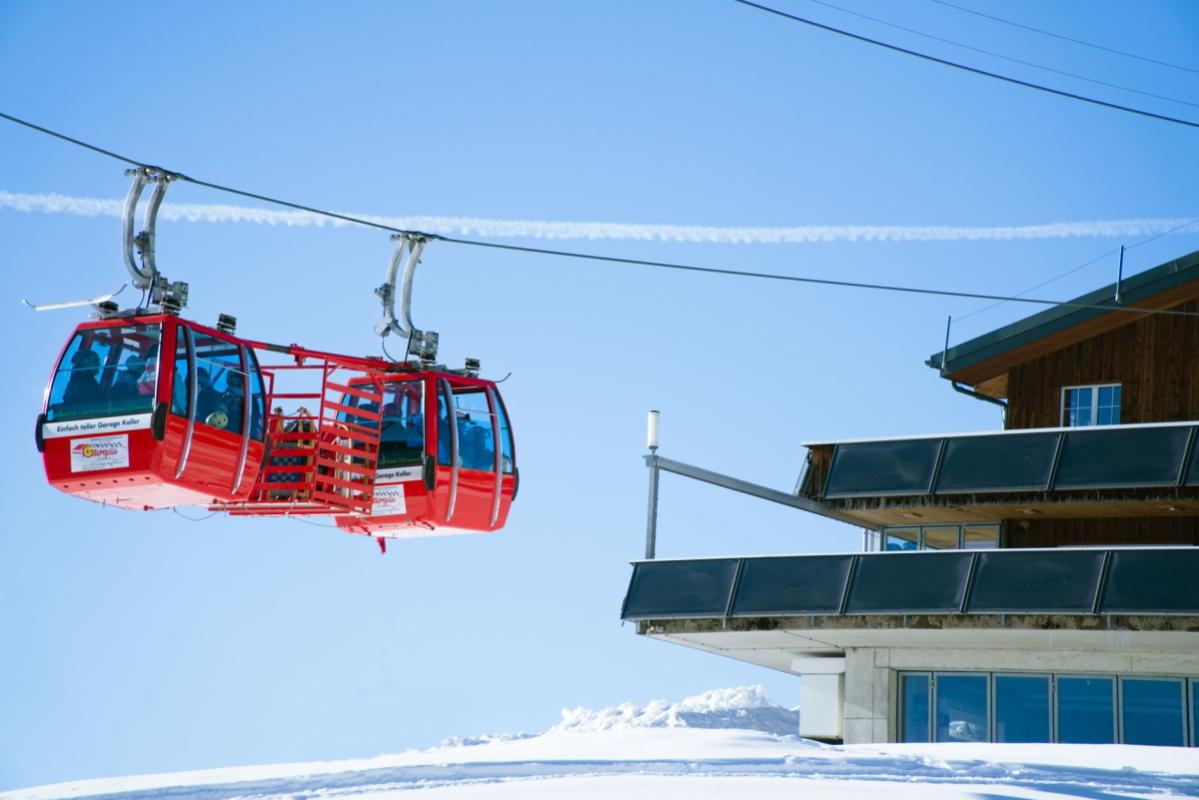
In Świeradów the Ski&Sun gondola is a clever shortcut to long descents and connectors to the Czech side. Each gondola is adapted for bike transport, and carrying bikes in the summer season usually doesn’t require an extra fee — you pay the standard ticket/pass and the bike goes “for free”[2][3]. There are also multi‑ride bike passes for sale (popular options: 4 and 8), valid for a set period — handy for a weekend or an intensive day[2].
How to manage it smoothly:
- Ticket: check the current prices and opening hours online, buy a ticket/pass and head to the gates.
- Loading: staff will point you to the right entrance; inside align the wheel straight, secure the brake, don’t lean the bike against the windows. Pack and small items go on the seats or on your lap.
- Ride plan: from the top station several directions branch off — a family variant to Hala Izerska, on to Chatka Górzystów; or toward the border and the Czech singletracks. Remember return time and leave a buffer for possible weather changes.
If something “snaps,” you have two main rescue routes: the official SKI&BIKE rental/service at the Ski&Sun centre (MTB and e‑MTB gear) and the city rentals at the lower station — quick, convenient, often able to perform service interventions on site[3]. The city listings also include places like “Pod Gondolą” and other addresses within walking distance of Źródlana — good for sudden pad swaps and adjustments after a tougher day.
Singletrack Glacensis: further, different, in loops
If you fancy a longer outing, Ziemia Kłodzka awaits with the Singletrack Glacensis network. It’s a different riding logic: an extensive system of loops, with recognisable access points and parking, clear colour coding and a more “touring” reach — ideal when you want to spend a day or a weekend linking several circuits without transfer logistics. Official materials state plainly the project scale: the network consists of 28 loops spread across Ziemia Kłodzka[5].
Practical differences you’ll notice right away:
- Scale and reach: instead of “one massif with many options” (Smrk/Świeradów), you get a mosaic of loops around several towns and passes. Navigation is clear, but plan your day with a map.
- Surface: similar to the Izeras, compacted, fast “narrow gravel” dominates, with natural sections and wooden boardwalks where moisture hangs around.
- Logistics: loops usually start and finish in the same place — easier to match kilometres to time and fitness; also easier to find service and food at trailheads.
Minimum plan? Download the map for offline use, because in valleys and beech draws the internet can be capricious. A good duo is: Mapy.cz (great contours and paths) and your favourite bike app with offline mode. Also remember the cross‑border nature of the region: trails and paths flow across the border; carry ID, and if you use e‑SIM or roaming, set data limits.
Workshop: a day‑of‑riding checklist
- Brake pads: visually (thickness) and “by ear” (when they squeal it’s too late). Carry spares.
- Tires: fresh sealant + fabric/tyre patches; an insert if you like lower pressures.
- Tools: multitool with valve tool, mini pump/CO₂, tubeless tyre plugger.
- Chain and cables: quick‑link + a short spare length of derailleur cable; a small roll of repair tape.
- Drivetrain hygiene: small bottle of “dry‑forest” lube, rag; better to top up after rain than carry a kilo of dusty paste.
- First aid and lights: in the Izeras dusk falls quickly under the canopy; a headlamp saves style and peace of mind.
- Water and calories: trail profiles are textbookly rolling — drink before you feel thirsty.
Trails and scenery: what to expect (and why you’ll love it)
Smrk, the highest summit of the Czech part of the Izera Mountains, watches the horizon here — under its arms lie the longest, houpavé descents down forested slopes[6]. On the Polish side loops circle closer to town: in one day you can warm up on a short blue, after a while “spin up” a red and finish with a descent from the gondola into the spa park. The character? Flowing, largely predictable; the technique is mostly reading turns, working the centre of gravity and maintaining cadence.
In the Bike Park (when the summer downhill programme runs) lines can be faster and denser in compressions — a natural moment to raise tyre pressure a notch, check pads and cool your ambitions with a first controlled run. The gondola always tempts you with “one more,” but your brakes and hands will be the first to tell you when enough is enough.
On Izera singletracks “fast” means “stable”. First the line and the eyes, then the crank and the hands. If you feel the levers become a panic handle — slow down by 10%. The flow won’t run away.
Close the loop: safety and etiquette
- Ride in the marked direction; treat the green connectors as two‑way tracks — look far and yield according to the rules[1].
- When overtaking, signal and leave room; stop in visible places, off the line of travel.
- After rain curb your ambitions: root + needles + gradient = an equation of variable slipperiness.
- You share the forest with walkers and wildlife; a bell on the bars solves many micro‑situations before they start.
The best thing about the Izeras is that you put the Allen key down and immediately feel the difference. The hum of gondola rollers, the silence of the forest, the soft scent of needles — and your bike simply “goes where you look.” Once you set up kit and habits here, you rarely return to the shop with complaints about the world. You usually come back for one more weekend.