After the Name, Before Memory: Where Bad Flinsberg Still Endures in Świeradów-Zdrój
Bad Flinsberg has not survived in Świeradów-Zdrój as a straightforward memento of an earlier name. It has been dispersed among the architecture of the Spa House, an underground exhibition, maps, urban trails and stories that must now be read carefully—separating source from legend.
You cannot enter the Spa Museum after 5 p.m. from Tuesday to Friday, while on Saturdays and Sundays the exhibition remains open until 6 p.m.[1]. If you want to combine the museum, the Spa House, Spa Park and the town route following the traces of the former resort, this is not a minor logistical detail but the point of departure: Świeradów-Zdrój’s memory is best viewed in the sequence dictated by opening hours, not by an aimless stroll.
The contemporary town does not preserve Bad Flinsberg in a single place. The former name has not been sealed in a display case or reduced to a caption beneath an old postcard. It endures in a building whose function is still connected with water; underground, where the history of the spa is presented alongside traces of mining; in maps and documents; in legends about the springs; and finally in the very way visitors are led through the centre.
A Name as a Record of Transition
The simplest version of this story would go like this: there was Bad Flinsberg, then Świeradów-Zdrój appeared, and between the two came a change of language and administration. The shorthand is convenient, but too smooth. Here, names do not form a single, indisputable line, and the town’s own materials show that its memory has several layers.
In the town’s official chronology, the names appear as follows: Flinsberg in 1524, Flinssberg in 1668, Bad Flinsberg in 1782, Wieniec Zdrój in 1945 and Świeradów-Zdrój in 1946[2]. This sequence makes clear that Bad Flinsberg does not represent the settlement’s entire earlier history. It is the name of a later, spa-centred chapter—a name associated with the resort, its infrastructure and its growing medical specialisation.
It is equally important to avoid conflating this date with something else. The year 1572 refers to Leonard Thurneysser’s description of Świeradów’s waters, not to the founding of the town, the creation of its name or the beginning of the settlement[2]. This distinction matters for more than a schoolbook chronology. It shows that Świeradów’s history developed simultaneously along several tracks: settlement, language, economy and spa culture.
After 1945, the name Wieniec Zdrój appeared, followed by Świeradów-Zdrój. Here, it is worth being cautious about stories of a single decision that instantly closed the previous chapter. The name change formed part of a broader post-war process of reorganising space: the administration, official language and population changed, but the buildings, the layout of the spa district and the springs remained in place. The new name therefore had to encompass a landscape that had not come into being in the new language.
That is why the question today is not: does Bad Flinsberg still exist? A better question is: in what form does its memory exist, and who gives it meaning?
A Resort Preserved in Its Material Fabric
The most compelling answer is the Spa House. Not because it has preserved every former meaning, but because it allows continuity and rupture to be observed in one place.
The present building was erected in 1899 on the site of the earlier Spring House, built in 1781 and destroyed by fire on 14 December 1895[3]. This is not merely a date in architectural history. It tells us that Bad Flinsberg’s material heritage does not consist in preserving every element unchanged. The resort also endured through rebuilding, modernisation and the assignment of new functions to older places.
The most recognisable part of the complex is the larch-wood Promenade Hall, built in 1899 and approximately 80 metres long. Its botanical polychrome decorations, stained-glass windows and the coat of arms of the von Schaffgotsch family above the stage have survived[3]. This is a space in which the resort’s former representational character has not merely been recreated in a photograph. You can still walk through the hall, see its structure and understand that the spa was not only a place for treatments, but also a carefully designed environment in which to stay.
A drinking pavilion operates by the entrance, and Świeradów’s waters retain their fundamental role: they are used for drinking and bathing treatments. Contemporary spa materials describe them as carbonated waters containing, among other elements, iron, fluoride and radon[3]. This is an important form of continuity, but it should not be confused with immutability. The way the waters have been described has changed along with the language of medicine, research techniques and the expectations of spa guests.
In the hall, two histories can therefore be read at once. One concerns architecture and the former model of the resort. The other is that of the contemporary spa, which still draws on the same landscape of springs but operates within a different organisational and cultural system. A preserved function does not mean a preserved audience, custom or language.
Spa Park works in much the same way. It is not a museum interior in which the past can be viewed behind glass. It is part of the everyday centre, a place of passage between the architecture of the Spa House and the town’s streets. In such a landscape, memory does not impose itself. You have to know what to look for: the promenade axis, the relationship between building and spring, the terraces, the former representational organisation of space.
Underground: A Museum That Brings the Story into Focus
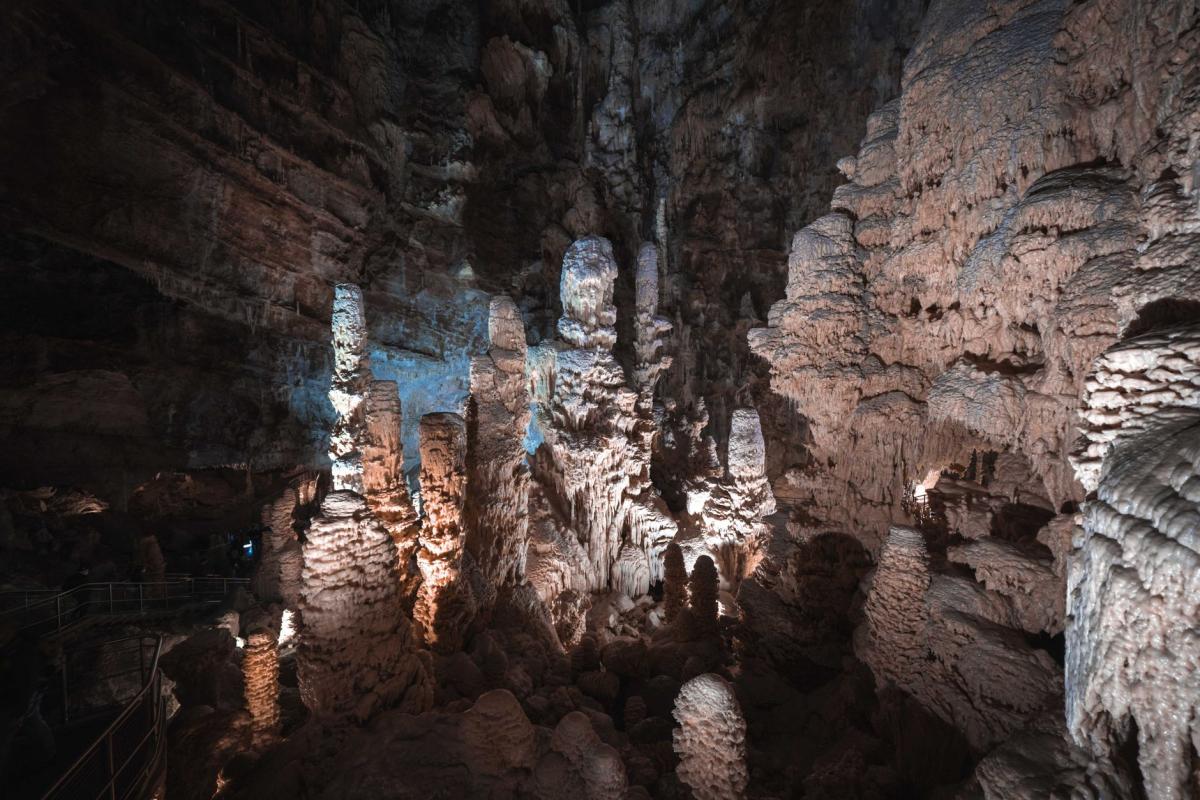
The Spa Museum is housed in the cellars of the Spa House and is also known as the Spa Mining Museum. It opened in 2014, marking the 260th anniversary of the first Świeradów springs being encased[4]. The choice of location is itself significant: visitors descend beneath a building whose grander areas tell the story of the resort through its façade, interiors and ceremonial character, while underground they see the infrastructure of the springs, extraction and treatment.
The exhibition presents the ways in which the springs have been used and the history of the spa. Alongside paintings on spa-related themes are objects connected with mining and sandstone figures, including representations of Saint Barbara[4]. This juxtaposition broadens the picture of Bad Flinsberg. The former resort was not merely an elegant promenade for guests. Its existence depended on labour, the extraction of raw materials, the study of the waters and the maintenance of infrastructure.
The museum also shows how easily three different levels of a story can be confused. The first is the written source: a description of the waters, a document, a plan, or information about construction or research. The second is a later historical interpretation that connects facts into a narrative about the spa’s development. The third is legend, necessary to the culture of a place but not evidence.
A good example is the story of the miraculous spring and the ancient cult associated with the figure of Flins. Local tradition connects it with the region’s earliest history, but when visiting, it is worth keeping it in the category of legend. The same applies to the story of Leonard Thurneysser and the dead frog observed near the spring. This tale appears in promotional and spa materials, but it does not replace the written source itself: the sixteenth-century description of the waters.
Such a distinction does not diminish the value of legends. On the contrary, it allows us to listen to them more attentively. A legend tells us how a community wishes to speak about its origins. A document tells us what can be confirmed. A museum should be a place where these systems meet without pretending that they are the same.
Maps, Exhibits and a Route Through Memory
Another important layer is preserved by the “A Memory of Świeradów-Zdrój” Gallery at the “IZERKA” Municipal Public Library. The exhibition includes photographs, documents, maps and paintings dating from the late nineteenth century to the outbreak of the Second World War. Its section entitled “Bad Flinsberg Until 1945” is set alongside later depictions of Świeradów-Zdrój[5].
This juxtaposition is more valuable than a single nostalgic image. A map shows the layout of a town, but not all of its residents’ experiences. A postcard highlights a façade while omitting service infrastructure, work and conflicts. A document confirms a particular fact, but does not automatically explain how it was experienced. That is why old materials are best viewed comparatively: check which buildings are still standing, which functions have survived and which have been replaced.
The town trail “In the Footsteps of Izera Mysteries” helps with this kind of reading. The route leads through 22 points marked by boulders bearing bas-reliefs and pictograms. They include the Spa House, the Spa Museum, Spa Park, the Culture Station and other places connected with the town’s history and landscape[6]. This is not a conventional trail through a single historic complex. It links points scattered across the town, showing that Świeradów’s memory is not confined to the spa district.
It is worth walking this section without treating it as an exercise in collecting attractions. At the Spa House, you can ask exactly what remains of the former resort model. In Spa Park: how does a public space change meaning once it no longer serves spa guests exclusively? In the museum: which elements of history have been selected for display? In the library: how does the image of the town change when, instead of a single building, we look at a map, a series of documents and post-war depictions?
The most interesting walk therefore does not lead from “old” to “new”. It moves between different ways of recording the past: façade, spring, underground, plan, caption, legend and urban marker. Each is incomplete. Only together do they offer a picture of a place that did not begin on a single date and did not end with a change of name.
What Remains After the Change of Language
The transformation of Bad Flinsberg into Świeradów-Zdrój did not erase the landscape, but it changed the instructions for reading it. The same stairs, terraces and walls began to function within a different symbolic order. Street names, captions beside exhibits and guides’ stories directed attention towards a new community, while the buildings continued to preserve traces of an earlier era.
Not every element was preserved. Some former functions disappeared, others were transformed, and many buildings are now viewed without a full understanding of their earlier purpose. Not everything that looks old is an authentic witness to Bad Flinsberg; nor does every story passed down as local tradition have the status of fact. Conscious sightseeing begins precisely with this refusal to simplify.
That is why it is worth using the name Bad Flinsberg precisely. It denotes the German-speaking, pre-war chapter in the resort’s history, but not the place’s entire past and not a straightforward synonym for the contemporary town. Świeradów-Zdrój is not a stage set representing a former settlement. It is a later layer that took over the existing layout, some of the buildings and the memory, then arranged them according to new needs.
If you begin at the museum, you will then have time to walk through the Promenade Hall, the drinking pavilion, the Spa House and Spa Park—not as a collection of attractions, but as a sequence of questions. Where does the document end and the legend begin? What has preserved its function, and what merely its form? Which traces are visible, and which must first be drawn out of a map or caption?
Bad Flinsberg has survived in Świeradów-Zdrój not because the former name remained official. It has survived because the town’s material fabric proved more durable than language, and contemporary memory—selective though it is—can still read that fabric.